INICIO / NOTICIAS / Noticias de la industria / Tipos de válvulas de bola de latón: la guía definitiva
2026-04-13
Contenido
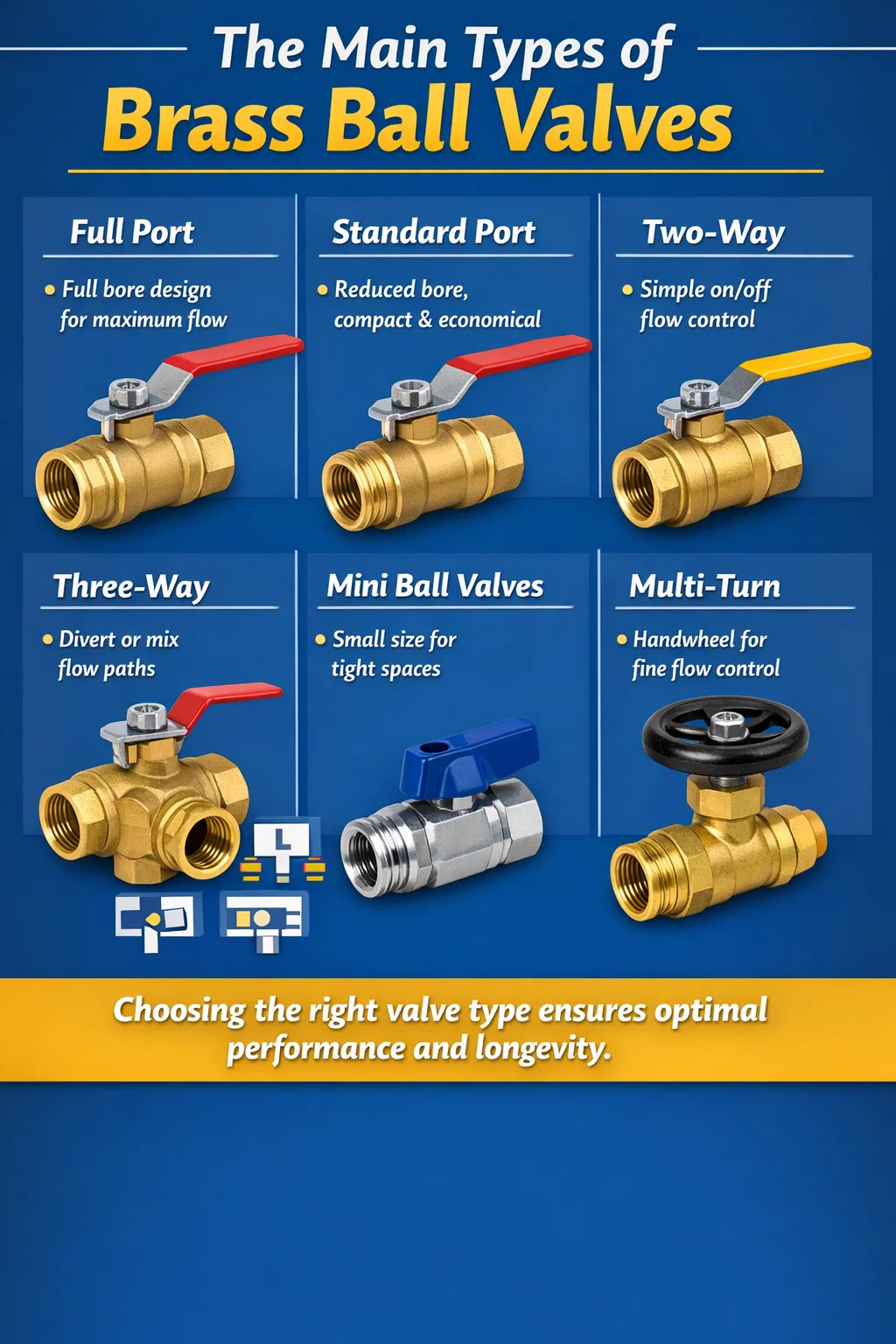
Latón válvulas de bola son dispositivos de cierre de un cuarto de vuelta que utilizan una bola giratoia con un orificio para controlar el flujo de fluido o gas. La respuesta corta: hay seis tipos principales: válvulas de bola de puerto completo, puerto estándar (puerto reducido), de dos y tres vías, miniválvulas de bola y válvulas de bola de múltiples vueltas, cada una diseñada para un rango de presión, condición de flujo o entorno de instalación específicos. Elegir el tipo incorrecto provoca fugas, pérdida de presión o fallas prematuras, por lo que comprender cada categoría antes de comprar no es opcional.
Latón remains the dominant material for residential and light commercial ball valve bodies because it balances corrosion resistance, machinability, cost, and pressure rating in a way that stainless steel and PVC cannot match at the same price point. A standard brass ball valve rated at 600 WOG (Agua, Petróleo, Gas) Maneja la gran mayoría de aplicaciones de plomería, HVAC y aire comprimido sin refuerzo adicional.
Esta guía cubre todos los principales tipos de válvulas de bola de latón, sus especificaciones nominales, casos de uso ideales y los detalles prácticos que los instaladores e ingenieros necesitan para hacer la selección correcta la primera vez.
Una válvula de bola de latón de paso total (también llamada paso total) tiene un diámetro interior que coincide con el diámetro interior de la tubería de conexión. Cuando la válvula está completamente abierta, el fluido pasa a través de ella con una restricción prácticamente nula, lo que significa que la caída de presión a través de la válvula es insignificante (generalmente menos de 0,5 PSI a caudales residenciales estándar .
Este diseño es obligatorio en aplicaciones donde no se puede sacrificar la capacidad de flujo, incluyendo:
Las válvulas de bola de latón de puerto completo son físicamente más grandes y pesadas que las equivalentes de puerto reducido del mismo tamaño nominal de tubería. Un cuerpo de válvula de puerto completo de 1 pulgada pesa aproximadamente 30-40% más que una versión de puerto estándar. Ese peso adicional se traduce directamente en costo, por lo que especificar un puerto completo en todo un sistema cuando un puerto reducido funcionaría igual de bien es un gasto innecesario.
| Tamaño nominal | Diámetro interior | Clasificación de presión típica | Cv (coeficiente de flujo) |
|---|---|---|---|
| 1/4" | 0,25" | 600 WOG | 2.2 |
| 1/2" | 0,50" | 600 WOG | 11 |
| 3/4" | 0,75" | 600 WOG | 23 |
| 1" | 1,00" | 600 WOG | 45 |
| 1-1/2" | 1,50" | 600 WOG | 108 |
| 2" | 2.00" | 600 WOG | 175 |
Las válvulas de bola de latón de puerto estándar, comúnmente llamadas de puerto reducido, utilizan un diámetro interior de bola que es un tamaño de tubería más pequeño que el tamaño nominal de la válvula. Una válvula de bola de puerto estándar de 1 pulgada tiene un diámetro interior de aproximadamente 0,75 pulgadas . Esta reducción crea una caída de presión mensurable pero hace que la válvula sea más pequeña, más liviana y menos costosa de fabricar.
En la mayoría de las aplicaciones de plomería residencial, esta caída de presión es completamente aceptable. Una válvula de puerto estándar en un ramal que alimenta un solo baño o cuarto de lavado no causará ninguna reducción notable en el rendimiento del artefacto. Los problemas surgen cuando se colocan múltiples válvulas de puerto reducido en serie en la misma línea: la pérdida de presión acumulada puede exceder 10 a 15 psi en el peor de los casos, lo que afecta la presión de la ducha y el rendimiento del aparato.
Las válvulas de bola de latón con puerto estándar dominan en estas situaciones:
Desde el punto de vista de la compra, las válvulas de bola de latón con puerto estándar cuestan 15-25% menos que los equivalentes de puerto completo de la misma presión nominal y tamaño nominal. En proyectos grandes con docenas o cientos de válvulas de aislamiento, esta diferencia es significativa.
Una válvula de bola de dos vías tiene una entrada y una salida: permite el flujo o lo detiene por completo. Esta es la configuración más común en plomería y HVAC. La bola gira 90 grados entre las posiciones completamente abierta y completamente cerrada, y la transición toma menos de un segundo.
Las válvulas de bola de latón de dos vías no están diseñadas para estrangular. Mantener una válvula de bola en una posición parcialmente abierta (digamos 45 grados) crea un flujo turbulento y de alta velocidad más allá del borde de la bola que erosiona los asientos de PTFE en semanas o meses. Las válvulas de bola son dispositivos de encendido/apagado. Si se necesita modular el flujo, la opción correcta es una válvula de globo o una válvula de aguja.
Las válvulas de dos vías están disponibles en múltiples configuraciones de conexión final, cada una de las cuales sirve para diferentes escenarios de instalación:
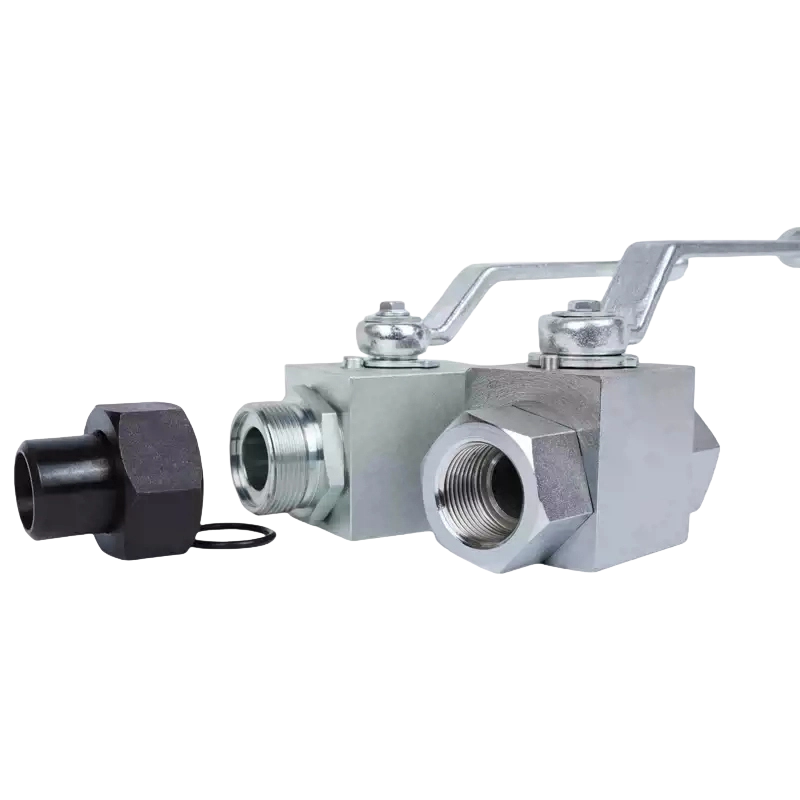
Las válvulas de bola de latón de tres vías tienen tres puertos y una bola especialmente perforada que dirige el flujo entre ellos. Reemplazan dos válvulas de dos vías separadas y un conector en T en aplicaciones donde el flujo debe desviarse, mezclarse o dividirse. Una única válvula de tres vías en un cuerpo compacto realiza el trabajo de tres componentes.
La bola dentro de una válvula de tres vías puede tener un orificio en forma de L o en forma de T, y la diferencia es crítica:
La bola del puerto L tiene una curva de 90 grados. En una posición, conecta el puerto A con el puerto B. Gire 90 grados y conecta el puerto B con el puerto C. En ningún momento los tres puertos se comunican simultáneamente. Esto hace que la válvula de puerto L sea adecuada para desviando flujo: enviar el fluido entrante a un destino u otro, pero nunca a ambos a la vez.
Las aplicaciones comunes del puerto L incluyen cambiar un sistema entre dos líneas de alimentación de químicos diferentes, alternar entre dos intercambiadores de calor o seleccionar entre un suministro primario y un circuito de derivación.
La bola con puerto en T tiene un orificio en forma de T que puede conectar los tres puertos simultáneamente, o dos de los tres, dependiendo de la posición de rotación. Esto lo hace adecuado para mezclando (dos entradas combinadas en una salida) o dividir (una entrada se divide en dos salidas).
Los sistemas de calefacción por piso radiante utilizan con frecuencia válvulas de bola de latón de tres vías con puerto en T para mezclar el agua de suministro caliente con agua de retorno más fría para lograr la temperatura correcta del piso, generalmente 85 a 120 °F (30 a 49 °C) — antes de que entre en la tubería del piso.
| Característica | Puerto L | Puerto T |
|---|---|---|
| Forma del orificio | curva de 90° | Orificio pasante en forma de T |
| Los 3 puertos se abren simultáneamente | No | Sí (en una posición) |
| Función primaria | Desviando | Mezclar o dividir |
| Rango de rotación | 90° | 90° o 180° |
| Aplicación típica | Selección química, conmutación de derivación | Calefacción radiante, estaciones de mezcla. |
Las miniválvulas de bola de latón sirven tamaños desde 1/8 de pulgada a 3/8 de pulgada nominal y ocasionalmente hasta 1/2 pulgada, según la definición de la línea de productos del fabricante. Se encuentran en todos los lugares donde las válvulas de tamaño completo no serían prácticas: equipos de laboratorio, instrumentos analíticos, puertos de servicio de refrigeración, máquinas de café, paneles de gases medicinales y pequeños circuitos neumáticos.
A pesar de su pequeño tamaño, las miniválvulas de bola de latón bien fabricadas mantienen el mismo diseño fundamental que sus primas más grandes: un cuerpo de latón, una bola de latón cromado o acero inoxidable y asientos de PTFE. Los valores de presión de las miniválvulas de calidad con frecuencia alcanzan 1000 WOG – más alto que muchas válvulas residenciales de tamaño completo, porque el diámetro pequeño requiere secciones de pared relativamente más gruesas.
Una nota de instalación importante: las miniválvulas de bola de latón requieren una llave (no apretarlas a mano) para las versiones con rosca NPT. El tamaño pequeño del puerto significa un alto torque de enganche de la rosca en relación con el tamaño del cuerpo, y un ajuste excesivo agrieta el cuerpo. El torque recomendado para accesorios de latón NPT de 1/8 de pulgada suele ser 10 a 15 libras-pie , mucho menos que los tamaños más grandes.
Cualquier válvula de bola de latón estándar se puede convertir a funcionamiento automatizado montando un actuador eléctrico o neumático en el vástago. El cuerpo de la válvula no cambia: el actuador reemplaza la manija manual y gira el vástago cuando se lo ordena una señal de control.
Los actuadores eléctricos aceptan un voltaje de control, comúnmente 24 VCA, 110 VCA o 220 VCA - y acciona un motorreductor que hace girar el vástago de la válvula. Los actuadores de dos posiciones (encendido/apagado) son los más comunes. Los actuadores modulantes aceptan una señal de 4 a 20 mA o de 0 a 10 V y pueden mantener cualquier posición intermedia, aunque, como se señaló anteriormente, el uso de una válvula de bola para estrangular acelera el desgaste del asiento.
Las válvulas de bola de latón accionadas eléctricamente aparecen en:
Los actuadores neumáticos utilizan aire comprimido, normalmente a 60 a 120 psi — para girar el vástago de la válvula. Operan más rápido que los actuadores eléctricos (a menudo menos de un segundo para un recorrido completo de 90 grados) y se prefieren en entornos donde las chispas eléctricas son un peligro, como áreas de manipulación de solventes o cabinas de pintura en aerosol.
Los actuadores neumáticos con retorno por resorte son un diseño de seguridad importante: el resorte fuerza a la válvula a una posición a prueba de fallas (abierta o cerrada) si se pierde presión de aire. Especificar falla de apertura versus falla de cierre es una decisión de ingeniería de seguridad que se debe tomar en función de las consecuencias de cada estado durante un apagado de emergencia.
La manija unida al vástago de la válvula determina cómo se opera la válvula y si es posible una operación accidental. La selección del mango rara vez se trata de preferencias: se trata de función y seguridad.
La manija de palanca es el estándar. Proporciona una indicación visual clara de la posición de la válvula: la manija paralela a la tubería significa abierta, perpendicular significa cerrada. Esta es la manija más rápida y fácil de operar y requiere un solo cuarto de vuelta. La indicación visual del estado de la palanca la hace invaluable en cualquier válvula que el personal de operaciones necesite verificar a distancia.
Un inconveniente: las palancas se abren o cierran fácilmente accidentalmente en espacios mecánicos congestionados. Las manijas de palanca de bloqueo abordan esto: incluyen una pestaña bloqueable que requiere un compromiso deliberado para operar la válvula.
El mango en T (barra en T) requiere dos manos o un esfuerzo deliberado para girar. Esto reduce el riesgo de operación accidental y es común en válvulas de servicio de gas, válvulas de aislamiento de equipos y cualquier aplicación donde la activación involuntaria tenga consecuencias significativas. Las manijas en T también son más compactas que las palancas en instalaciones confinadas.
Los mangos ovalados son compactos y tienen una forma ergonómica para operar con los dedos y el pulgar. Aparecen con frecuencia en tamaños de válvulas más pequeños (1/4 a 1/2 pulgada) en conexiones de electrodomésticos, equipos de laboratorio y paneles de instrumentos donde no encajaría una manija de palanca completa.
Las manijas de bloqueo incorporan un cerrojo de candado o un mecanismo de bloqueo incorporado que evita el funcionamiento de la válvula sin un desbloqueo deliberado. Estos son requeridos en los procedimientos de bloqueo/etiquetado (LOTO) de OSHA, donde el aislamiento de energía durante el mantenimiento debe ser verificable y resistente a manipulaciones. Las instalaciones que dan servicio a maquinaria conectada a líneas presurizadas deben tener válvulas bloqueables en los puntos de aislamiento.
Más allá de las configuraciones estándar, varios diseños de válvulas de bola de latón especializadas abordan requisitos industriales específicos que las válvulas estándar no pueden cumplir.
Las válvulas de bola de latón aptas para gas están probadas y certificadas específicamente para su uso con gas natural, gas LP y gas mixto. En los Estados Unidos, estas válvulas deben llevar AGA (Asociación Americana del Gas) aprobación o cumplir con los estándares ANSI Z21.15. La diferencia con una válvula de bola de agua no siempre es visible externamente: los sellos internos y los materiales del asiento se seleccionan para resistir la permeación y el hinchamiento de los hidrocarburos, y la válvula debe pasar pruebas de fugas a presión nominal con gas, no solo con agua.
El uso de una válvula de bola sin clasificación para gas en una línea de gas es una violación del código en la mayoría de las jurisdicciones y un verdadero peligro para la seguridad. Siempre verifique la marca de certificación en el cuerpo de la válvula antes de la instalación en cualquier servicio de gas.
Latón ball valves used in oxygen service must be thoroughly degreased and cleaned before installation. Any hydrocarbon contamination — including normal machining oils — can ignite violently in contact with high-pressure oxygen. Oxygen-service valves are clearly marked and should nunca mezclar con stock estándar . Son obligatorios procedimientos específicos de almacenamiento y manipulación.
Las válvulas de bola ventiladas tienen un pequeño orificio perforado a través de la bola. Cuando la válvula se cierra, este orificio de ventilación se alinea con el puerto aguas abajo y purga la presión atrapada a la atmósfera (o a un punto de recolección). Este diseño se utiliza cuando la presión atrapada entre una válvula cerrada y el equipo aguas abajo podría causar un peligro: sistemas de aire comprimido, servicio de vapor y procesos químicos donde la liberación de presión antes del mantenimiento es un requisito de seguridad.
Los asientos de PTFE estándar se derriten en un incendio, lo que provoca que una válvula de bola tenga fugas o no se abra. Las válvulas de bola a prueba de incendios incorporan un asiento secundario de metal con metal detrás del asiento de PTFE. Si el asiento de PTFE es destruido por el fuego, el asiento de metal toma el control y mantiene el cierre. Las válvulas contra incendios se prueban para API 607 or ISO 10497 y son obligatorios en muchas aplicaciones de tuberías industriales, petroquímicas y de refinería.
Dos válvulas de bola de latón pueden parecer idénticas por fuera y funcionar de manera completamente diferente con el tiempo. Los detalles de construcción interna determinan la vida útil, la integridad de las fugas y el par de funcionamiento después de años de uso.
La bola en sí suele estar hecha de latón cromado o acero inoxidable 316. Las bolas de latón cromado son estándar en la mayoría de las válvulas residenciales y comerciales; el cromo proporciona una superficie dura y lisa que reduce el desgaste del asiento y previene la corrosión. La capa de cromo debe aplicarse uniformemente; El revestimiento delgado o desigual desarrolla picaduras de corrosión que rasgan los asientos de PTFE en cada ciclo.
Las bolas de acero inoxidable son más duras, más resistentes a la corrosión y más adecuadas para medios agresivos: agua desionizada (que lixivia metales), ácidos diluidos y productos químicos oxidantes que atacan al cromo. La prima en costo vale la pena en esas aplicaciones específicas.
Los asientos de PTFE (politetrafluoroetileno, teflón) son el estándar de la industria. El PTFE es químicamente inerte a casi todos los fluidos, tiene una fricción extremadamente baja y proporciona un sellado excelente a presiones desde casi el vacío hasta varios cientos de PSI. Su limitación es la temperatura: el PTFE estándar se ablanda por encima 250°F (121°C) , lo que lo hace inadecuado para el servicio de vapor sin formulaciones especiales.
El PTFE reforzado (relleno de vidrio, carbono o acero inoxidable) mejora la resistencia a la temperatura, la resistencia al desgaste y la estabilidad dimensional a presiones más altas. Las aplicaciones de alta temperatura empujan los materiales del asiento hacia PEEK (poliéter éter cetona), que soporta temperaturas hasta 500°F (260°C) .
El número de piezas del cuerpo determina si la válvula se puede reconstruir en el campo:
En un entorno residencial, las válvulas de bola de latón de una y dos piezas son totalmente apropiadas. En una sala de máquinas comercial con válvulas en tramos de tubería de difícil acceso, La construcción de tres piezas ahorra importantes costes laborales durante la vida útil de la instalación. .
Latón ball valve pressure ratings use the WOG system — Water, Oil, Gas — which specifies the maximum working pressure at ambient temperature (typically 73°F/23°C). The most common rating for standard brass ball valves is 600 WOG (aproximadamente 600 PSI) . Esto supera con creces los requisitos del suministro de agua residencial (la presión municipal rara vez supera los 80 PSI) y la mayoría de los sistemas HVAC comerciales.
La cuestión crítica es que las clasificaciones WOG se aplican sólo a temperatura ambiente. A medida que aumenta la temperatura, el cuerpo de latón pierde resistencia y los asientos de PTFE se ablandan. Esto se expresa como un factor de reducción. Una válvula con clasificación de 600 WOG a 73 °F solo podría tener una clasificación de 150 PSI a 200°F (93°C) . Siempre verifique la curva de presión-temperatura (P-T) del fabricante, no solo el sello WOG en el cuerpo, cuando la aplicación implica temperaturas elevadas.
| Temperatura (°F) | Temperatura (°C) | Presión máxima aproximada (PSI): válvula 600 WOG |
|---|---|---|
| 73 | 23 | 600 |
| 100 | 38 | 540 |
| 150 | 66 | 420 |
| 200 | 93 | 300 |
| 250 | 121 | 150 |
El servicio Steam merece una mención especial. Las válvulas de bola de latón estándar generalmente no recomendado para vapor . El vapor a baja presión (hasta 15 PSI) a veces se maneja mediante válvulas de latón con materiales de asiento adecuados, pero cualquier valor superior requiere una construcción de acero inoxidable o acero al carbono con asientos de metal. El uso de una válvula de bola de latón estándar con vapor provoca una rápida degradación del asiento y una posible falla del cuerpo.
El latón estándar es una aleación de cobre y zinc, normalmente en una proporción de aproximadamente 60% cobre a 40% zinc (Latón C36000 de libre mecanizado). En determinadas condiciones del agua (agua blanda, agua ácida (pH inferior a 7), agua tibia o agua con alto contenido de cloruro), el zinc se lixivia selectivamente del latón en un proceso llamado descincificación. El cuerpo de la válvula pierde progresivamente zinc, dejando una estructura de cobre débil y porosa que eventualmente falla.
El latón resistente a la descincificación (DZR), también llamado CW602N o C35300, limita el contenido de zinc a menos del 15 % y agrega arsénico u otros inhibidores que bloquean el proceso de lixiviación. En áreas con agua agresiva (que incluye muchos suministros municipales en Europa y partes de EE. UU.), las válvulas de bola de latón DZR son obligatorias. según los códigos de plomería locales.
Los signos visuales de descincificación (decoloración rosada o rojiza en la superficie del latón, depósitos de polvo blanco o debilidad estructural) generalmente se detectan demasiado tarde. Seleccionar latón DZR desde el principio es mucho menos costoso que reemplazar la válvula después de una falla.
Las válvulas de bola de latón DZR se pueden identificar por la marca DZR estampada en el cuerpo o por la especificación del material en la hoja de datos del producto. cuestan 10-20% más que las válvulas de latón estándar, pero son la única opción aceptable para el servicio de agua potable en las regiones afectadas.
El latón tradicional de mecanizado libre (C36000) contiene hasta 3% de ventaja , que mejora drásticamente la maquinabilidad pero genera preocupaciones sobre la lixiviación de plomo en el agua potable. En respuesta, Estados Unidos promulgó la Ley de Reducción de Plomo en el Agua Potable, vigente a partir del 4 de enero de 2014, que restringe el contenido de plomo de las superficies mojadas en productos de plomería para el servicio de agua potable a un promedio ponderado de 0,25% o menos .
Las aleaciones de latón sin plomo utilizadas en válvulas de bola que cumplen con las normas incluyen:
Para cualquier válvula de bola instalada en una línea de agua potable en los Estados Unidos, California (AB 1953), Vermont, Maryland, Luisiana u otros estados con restricciones independientes sobre el plomo, La certificación sin plomo (NSF/ANSI 61 y NSF/ANSI 372) no es opcional. — es un requisito legal. Verifique siempre las marcas de certificación NSF antes de comprar válvulas para sistemas de agua potable.
La selección se reduce a responder una serie de preguntas específicas sobre la aplicación. Trabajar con ellos sistemáticamente elimina rápidamente las opciones incorrectas.
Revisar esta lista de verificación antes de realizar el pedido evita el error común de comprar solo por precio y luego descubrir que la válvula no es adecuada para la aplicación. Una válvula de $12 que debe ser reemplazada después de seis meses porque carecía de protección DZR o de la certificación correcta cuesta mucho más en mano de obra que comprar la válvula correcta de $18 en primer lugar.
Comprender por qué fallan las válvulas de bola de latón ayuda tanto a seleccionar la válvula adecuada inicialmente como a diagnosticar problemas en las instalaciones existentes.
El flujo pasa a través de una válvula completamente cerrada. Causas: asientos de PTFE desgastados por el uso de aceleración, daños en el asiento por partículas en el fluido, deformación del asiento por exposición a sobretemperatura o asientos que nunca se asentaron correctamente debido a un defecto de fabricación. Prevención: utilice la válvula únicamente como dispositivo de encendido/apagado, instale un filtro aguas arriba en sistemas sucios y verifique la compatibilidad de temperatura antes de la instalación.
Fugas de líquido desde el área de empaquetadura del vástago. Causas: desgaste de la empaquetadura por ciclos frecuentes, degradación de la empaquetadura por temperatura o exposición a químicos, o torque de instalación inadecuado que distorsionó el área del sello del vástago. En válvulas de empaquetadura ajustable, apretando la tuerca prensaestopas de 1/8 a 1/4 de vuelta a menudo detiene una fuga en el vástago sin reemplazar la válvula. Los diseños no ajustables requieren reemplazo de válvula.
La pelota no se puede girar. Causas: inactividad prolongada que permite que se acumulen depósitos minerales entre la bola y los asientos, descincificación que hincha el cuerpo alrededor de la bola o empaquetadura demasiado apretada hasta el punto de atascar el vástago. Prevención: ejercitar las válvulas (abrirlas y cerrarlas completamente) al menos una vez al año. Esta es una práctica estándar en el mantenimiento de instalaciones y evita la situación en la que una válvula ha estado abierta durante años y no puede cerrarse durante una emergencia.
Agrietamiento físico o división del cuerpo de latón. Causas: descincificación que ha debilitado la estructura metálica, picos de presión de golpe de ariete que excedieron la clasificación de la válvula, congelamiento del agua atrapada (el agua se expande aproximadamente 9% en volumen cuando se congela, generando presiones que agrietan fácilmente el latón), o el torque de instalación aplicado al cuerpo de la válvula en lugar del accesorio. El aislamiento y drenaje de todas las válvulas en lugares expuestos al congelamiento antes del invierno no es negociable en climas fríos.
Latón ball valves dominate the residential and commercial market, but they are not the correct material for every application. Understanding where stainless steel or PVC performs better prevents costly mistakes.
| Propiedad | Latón | Acero inoxidable 316 | PVC |
|---|---|---|---|
| Temperatura máxima | 250°F (121°C) con asientos de PTFE | 450°F (232°C) | 140°F (60°C) |
| Agua de mar / agua salada | Pobre (riesgo de descincificación) | Excelente | Excelente |
| Agua Potable | Bueno (se requiere grado sin plomo) | Excelente | bueno |
| Ácidos diluidos | pobre | bueno (depends on acid) | Excelente |
| Clasificación de presión | Hasta 600 WOG (estándar) | Hasta 1000 PSI | 150 PSI típico |
| Costo relativo (válvula de 1") | $15–$35 | $40–$100 | $8–$20 |
| Servicio de Gas Natural | Sí (grado certificado por AGA) | si | No |
La conclusión práctica: las válvulas de bola de latón son la elección correcta para la gran mayoría de aplicaciones de agua, gas, petróleo y aire comprimido en entornos comerciales y residenciales. Cambie a acero inoxidable cuando la temperatura exceda los 250 °F, cuando el fluido sea corrosivo para el zinc o el cobre, o cuando el sistema esté en un ambiente marino. Cambie a PVC cuando el fluido sea un ácido, álcali u oxidante fuerte que ataque a todos los metales, pero acepte las limitaciones de temperatura y presión que conlleva.
Incluso la válvula correcta falla prematuramente si se instala incorrectamente. Estas prácticas se aplican independientemente del tipo de válvula seleccionado.
Las roscas NPT (National Pipe Tapered) se sellan mediante interferencia de roscas más un sellador. La cinta de PTFE (2 o 3 vueltas en la dirección de la rosca) o el sellador anaeróbico para roscas de tuberías funcionan. No aplique sellador a las dos primeras roscas; entrará en el interior de la tubería. En servicio de gas, utilice una cinta de PTFE amarilla clasificada para gas o un sellador de roscas compatible con gas. La mayoría de los códigos no aprueban la cinta de PTFE blanca estándar para servicio de gas.
Aplique torsión con la llave a las partes planas de la llave en la conexión final más cercana al accesorio de tubería, nunca al cuerpo de la válvula en sí. Apretar el cuerpo lo retuerce y lo distorsiona, atascando la bola contra los asientos y provocando una falla inmediata o temprana. Utilice dos llaves al instalar válvulas roscadas en tuberías existentes: una para mantener quieto el cuerpo de la válvula y otra para girar el conector de la tubería.
Al soldar una válvula de bola de latón en una tubería de cobre, mantenga la válvula en la posición completamente abierta durante la soldadura. Esto aleja los asientos de PTFE de la parte más caliente del cuerpo de la válvula y reduce el riesgo de que el asiento se derrita o se distorsione. El sobrecalentamiento de los extremos de soldadura, especialmente en válvulas más pequeñas, es una de las causas más comunes de fugas en instalaciones nuevas. Utilice un disipador de calor o un trapo húmedo en el cuerpo de la válvula si los accesorios de la tubería requieren un tiempo de soplete prolongado.
Las válvulas de bola de latón de dos vías estándar son bidireccionales: el flujo puede ingresar por cualquier extremo. Las válvulas de tres vías son direccionales y deben instalarse según la designación de puerto del fabricante. Las válvulas accionadas pueden tener una dirección de flujo preferida marcada en el cuerpo. Consulte la documentación del producto antes de asumir que cualquier válvula especial es bidireccional.
Latón ball valves function correctly in any orientation — horizontal, vertical, or angled — without adjustment. The exception is where solids or sediment in the fluid could settle inside the valve body when it is installed with the stem pointing downward. For dirty or slurry service, installing with the stem pointing upward or horizontally allows solids to be flushed out when the valve operates.
Productos recomendados
Derechos de autor © YANCHENG YANYE HYDRAULIC PARTS CO., LTD. Todos los derechos reservados




 English
  русский
  Español